Key Takeaways
- Flexible metal hose should be selected based on actual service conditions, not just diameter.
- Temperature, pressure, media, vibration, movement, and available routing space all affect performance.
- Corrugated hose, interlocked hose, and braided assemblies solve different connection challenges.
- Correct length, bend radius, alignment, and support can help prevent fatigue and premature failure.
- Routine inspection helps identify wear before it becomes a leak, shutdown, or equipment problem.
Facilities in Addison, Illinois, often need flexible connections where rigid piping or ductwork meets equipment that runs hot, vibrates, or is installed in a compact mechanical area. Whether the application involves process exhaust, air movement, material handling, or equipment protection, selecting the right flexible assembly starts with understanding how it will actually be used.
For local maintenance teams and fabricators evaluating options for aluminum ducts Addison IL, the goal is not simply to find a hose that fits between two points. The assembly needs to accommodate its media, temperature range, pressure conditions, movement pattern, fittings, and surrounding environment without placing unnecessary strain on connected equipment.
Why Flexible Metal Hose Still Matters
Flexible metal hose provides a controlled transition between rigid components. A pump, compressor, furnace connection, exhaust run, or fan system may transmit vibration into nearby piping. Equipment can also shift slightly during operation, maintenance, or temperature changes. A properly selected hose can help isolate some of that motion and reduce stress at adjacent fittings.
That does not make every flexible hose a replacement for pipe or a cure for poor alignment. A hose is a purpose-built component with limits for pressure, movement, bending, and temperature. Treating it as a catch-all solution can shorten its useful service life.
Start With the Service Conditions
Before requesting a quote or ordering an assembly, document the application details. A clear specification helps avoid assumptions that can lead to an unsuitable hose selection.
- Size: Confirm the required inside diameter, outside clearance, and connection dimensions.
- Temperature: Record normal operating temperature as well as minimum and maximum conditions.
- Application: Identify whether the hose is intended for vibration isolation, thermal growth, flow transfer, or limited equipment movement.
- Media: Define what moves through the assembly, such as air, gas, vapor, liquid, exhaust, powder, or particulate.
- Pressure: Include normal working pressure, possible surge pressure, and any vacuum requirement.
- End fittings: Match threads, flanges, weld ends, clamps, and sealing surfaces to the existing system.
- Dynamics: Describe the direction, frequency, speed, and distance of expected movement.
Choose the Right Hose Construction
Corrugated Metal Hose
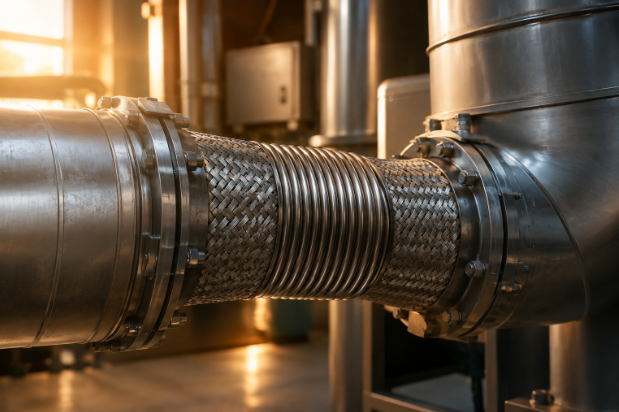
Corrugated metal hose uses formed convolutions to provide flexibility while maintaining a sealed flow path. It is commonly considered for applications involving temperature, pressure, vacuum, and vibration. A wire braid may be added around the corrugated core to support internal pressure forces and provide exterior protection. The basic differences between corrugated and stripwound designs are explained in this overview of metal hose construction.
Interlocked Metal Hose
An interlocked hose is formed from overlapping metal strips that create a flexible mechanical conduit. It can be useful for air routing, exhaust handling, cable protection, and selected material-handling applications. Because the overlapping construction may not be fully gas-tight on its own, a packing material, liner, or alternate design may be needed when leakage control is important.
Braided Assemblies
Single-braid, double-braid, and heavier braided assemblies can offer different levels of pressure support. However, additional braiding does not automatically make a hose suitable for every type of motion. The assembly must still be installed with sufficient length, correct bend geometry, and freedom from twisting. A damaged or flattened braid can also reduce the protection and support that the assembly was designed to provide.
Match Materials to the Environment
Material selection affects both the hose body and the fittings. Stainless steel is frequently considered where corrosion resistance and elevated-temperature capability are needed. Galvanized steel may suit certain general-purpose applications, while aluminum can be appropriate for selected lightweight air and ducting uses. Compatibility depends on the conveyed media, humidity, chemical vapor, outdoor exposure, temperature, and cleaning practices.
For example, an outdoor exhaust connection exposed to moisture may require different material considerations than an indoor protective conduit. Likewise, a hose exposed to chemical vapor or hot exhaust should be reviewed for both internal and external corrosion risks.
Account for Heat and Thermal Growth
Metal piping, ducts, and connected equipment can change dimensions as temperatures rise or fall. In Addison facilities, this can matter where heated process equipment operates in spaces that also experience seasonal temperature variation. A hose should not be pulled tight and expected to absorb all movement. It needs enough installed length and the correct configuration to move within its design limits.
Insulation, heat shields, and protective sleeves may help protect nearby components from radiant heat, sparks, or hot surfaces. Always review temperature capability together with pressure, since published ratings can vary under full operating conditions.
Control Vibration Without Creating New Problems
Steady vibration, occasional equipment movement, and repeated flexing are different service conditions. Vibration can contribute to braid wear, fatigue near corrugations, loosening at connections, and eventual leakage if the assembly is poorly supported or incorrectly routed. A published failure analysis of corrugated hose reinforces the need to evaluate pressure, dimensions, and vibration together rather than treating any one factor in isolation.
Independent pipe supports are essential. The hose should accommodate intended movement, not carry the weight of unsupported piping, ducting, valves, or attached equipment.
Measure Length and Bend Radius Correctly
- Measure between the actual connection points.
- Allow enough length for the required bend shape and expected movement.
- Stay within the manufacturer’s stated minimum bend radius.
- Avoid sharp bends immediately next to fittings.
- Leave adequate clearance for inspection, removal, and maintenance access.
A useful installation diagram compares a relaxed, properly supported hose with an assembly that is twisted, stretched, or sharply bent at one end. The visual difference makes it easier to identify avoidable installation stress.
Understand Hose Versus Expansion Joints
A flexible hose can meet certain connection and movement requirements, but it is not a universal expansion joint. Systems with significant axial, lateral, or angular thermal movement may require a purpose-designed bellows expansion joint or another engineered component. The selection should reflect the movement type, cycle frequency, anchors, guides, and piping layout.
Installation and Inspection Checklist
- Align the hose with the intended direction of movement and prevent torsion during installation.
- Use proper supports, seals, clamps, gaskets, or fittings for the connection style.
- Protect the assembly from sharp edges, abrasion, impact, sparks, and unnecessary heat exposure.
- Do not force a hose into place to correct major pipe misalignment.
- Inspect for broken braid wires, dents, flattening, kinks, corrosion, discoloration, leaks, and residue around fittings.
- Check nearby supports and anchors, listen for unusual pulsation, and record inspection dates.
Conclusion
Choosing a flexible metal hose for an Addison, Illinois application is easier when the entire operating environment is considered before the assembly is specified. Review media, pressure, temperature, movement, fittings, materials, available space, and maintenance access together. A correctly selected and properly installed hose can support reliable equipment operation, while regular inspection helps identify developing problems before they interrupt production.